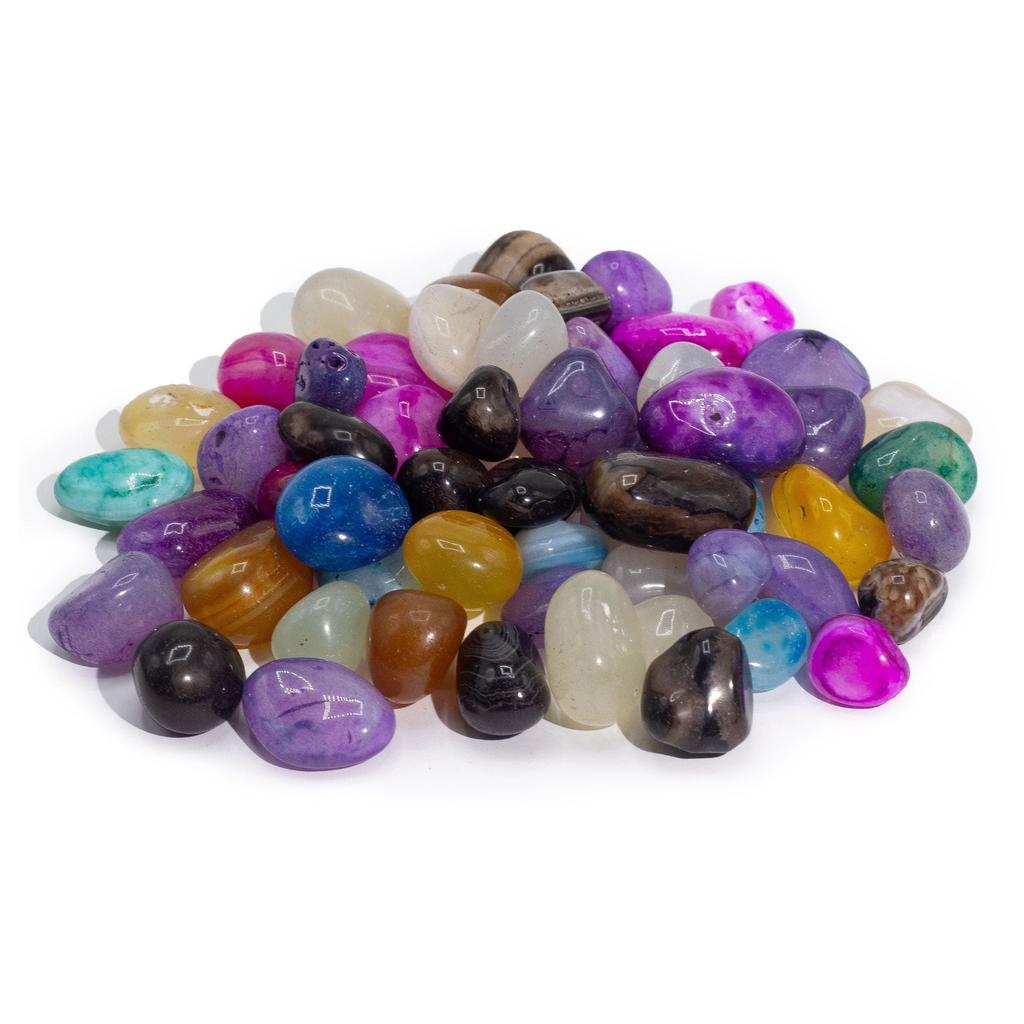
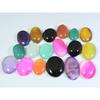
A 1kg bag of tumbled agate stones in seven colours — approximately 70 individual stones, each polished smooth and dyed to produce vivid, saturated colour.
What You Get
Approximately 70 tumbled stones in a mix of seven colours. The exact colour assortment varies between bags, but typically includes blues, greens, purples, pinks, reds, oranges, and teals — a broad, vibrant spectrum.
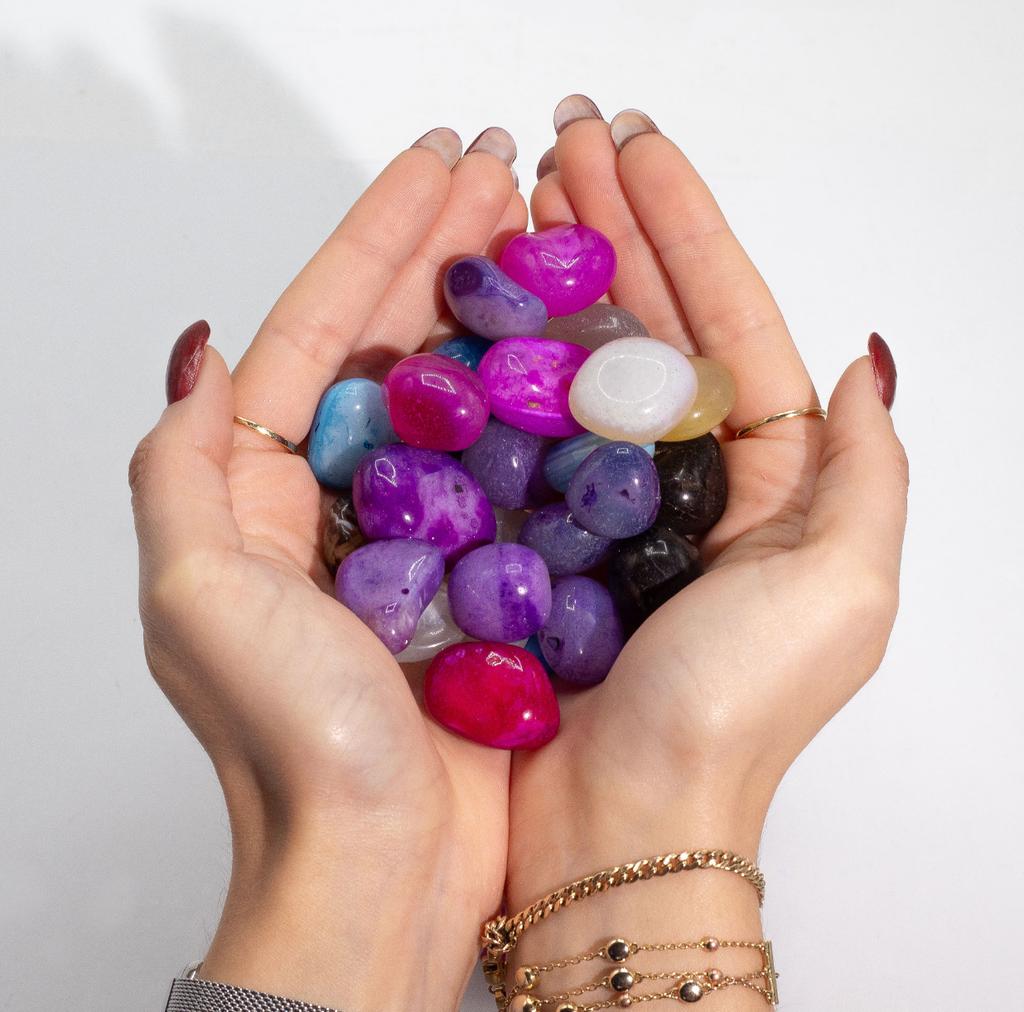
Each stone is roughly 20–30 mm — palm-sized for individual display, small enough to use in jewellery, resin work, mosaics, or decorative arrangements.
Tumbled and polished. The stones have been mechanically tumbled to remove rough edges and produce a smooth, rounded finish with a soft sheen. They feel pleasant in the hand and catch light gently.
Treated (dyed). These agates have been colour-enhanced using standard gemstone dyeing techniques. Agate is one of the most commonly dyed stones in the industry because its porous, banded structure absorbs colour beautifully and holds it well. The result is vivid, consistent colour that natural agate rarely achieves on its own. More on this below.
What "Treated" Means — And Why It Matters to Be Honest About It
Agate in its natural state is typically grey, white, or pale brown, sometimes with subtle banding in soft earth tones. It is a beautiful stone in its own right, but it does not naturally occur in the bright blues, vivid greens, or saturated pinks you see in this bag. Those colours come from dyeing — a process where the porous stone is soaked in a colouring solution that penetrates the bands and layers of the agate, producing rich, even colour throughout.
Dyeing agate is one of the oldest treatments in the gemstone trade. It has been practised since at least Roman times and is considered standard in the industry. It does not damage the stone or change its mineral structure — it simply adds colour. The treatment is permanent under normal conditions: the colour will not wash out, bleed, or fade with everyday handling. However, prolonged soaking in water or exposure to strong chemicals may affect the dye over time, so it is worth keeping this in mind if you plan to use the stones in an aquarium or water feature.
We mention this because transparency matters. These are genuine agate — a variety of chalcedony, itself a form of microcrystalline quartz — but their colour is enhanced, not natural. If you are buying for crystal healing or metaphysical purposes, you should know that some practitioners believe dyeing affects a stone's energetic properties while others consider the base mineral to be what matters. We leave that to your own judgement.
What Is Agate?
Agate is a banded variety of chalcedony — a microcrystalline form of quartz (silicon dioxide, SiO₂). It forms inside volcanic rock cavities when silica-rich solutions slowly deposit layer upon layer over thousands or millions of years, creating the characteristic bands and patterns that make agate distinctive. It rates 6.5–7 on the Mohs hardness scale, making it durable enough for jewellery, handling, and everyday display without scratching easily. Agate is found worldwide — major sources include Brazil, India, Madagascar, and Uruguay — and has been used in jewellery, amulets, and decorative objects for at least 3,000 years.
What People Use These For
A 1kg bag of mixed agate is a versatile supply. Common uses include jewellery making (wire wrapping, macramé, cage pendants), resin art and orgonite production, mosaic and craft projects, decorative bowls and vase fillers, plant pot toppings, aquarium and terrarium decoration (check dye stability for prolonged water exposure), crystal grids, chakra layouts, and retail resale as individual stones. The seven-colour mix is also popular for children's craft activities and school projects where a variety of bright, tactile stones is useful.
Physical Details
1 kg bag of treated (dyed) mixed agate tumble stones
Approximately 70 stones per bag (natural variation in stone size and density means this is an estimate)
7 colour varieties in each bag
Individual stone size approximately 20–30 mm
Tumbled and polished to a smooth finish
Hardness: 6.5–7 Mohs (durable, scratch-resistant under normal use)
Each stone is unique — shapes, banding patterns, and colour intensity will vary
A Note on Gifting
A bag of mixed agate stones is a generous, open-ended gift — particularly for anyone who makes jewellery, works with resin, or collects crystals. The seven-colour variety makes it visually striking straight out of the bag, and the quantity means the recipient can use them across multiple projects. For children interested in rocks and minerals, a bag of colourful tumbled stones is one of those gifts


 No-delivery refund




![Natural Amethyst 1000g Healing Gravels, Size Approx. 5mm-20mm, 100g, 500g, (1kg), Purifying, (1000 Grams) [Used]](https://img.joomcdn.net/f070d83a1f8bc0c39fe1dfe147a291d1c25e9d08_100_100.jpeg)


![[GOLD STONE] Super Seven Pebbles 100g Small Quartz with Other Minerals Entrapped Purification Goods Nail Parts Natural Stone Power Stone](https://img.joomcdn.net/4d6cba7ecfbfab5a6ef0a18820624bbe450c2dd4_100_100.jpeg)