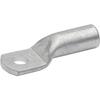
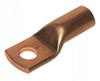
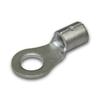
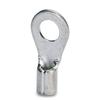
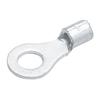
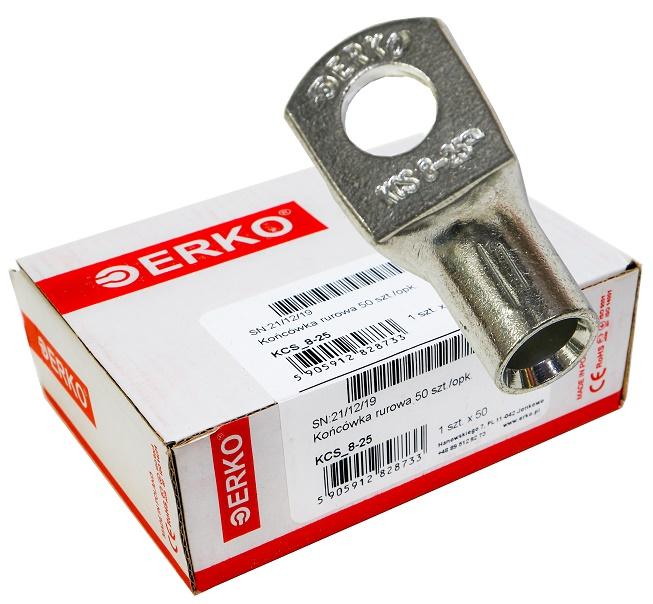
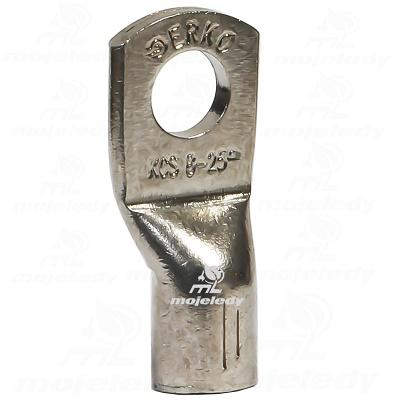
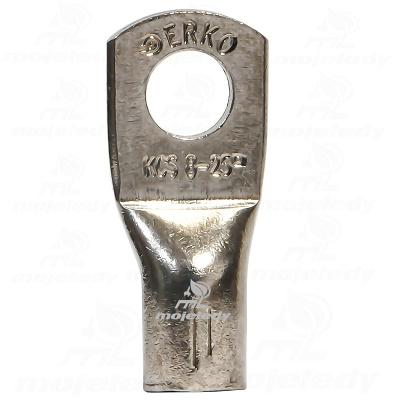
Ring terminal Cu tubular KCS 8-25 50pcs.
Technical data
Producer: ERKO
Product series: KCS
Manufacturer index: KCS_8-25/50
EAN 5905912828733
Eyelet tip shape
Simple connection angle
Material Copper
Model without a collar
Type of cable Multi-core
Metric thread size of the connection mm2 8
With insulation NO
With inspection hole NO
Surface protection Tinning
Rated cross-section [mm2] 25
Copper tube eyelet terminals DIN series (electrolytically galvanized) in accordance with
DIN 46235 standard, for crimping. They allow the termination of cable conductors
copper, are used where the need for connection arises
wire to e.g.. distribution board, busbar, or other device by means of
screw clamp. The use of DIN ring terminals increases
safety and durability of this type of connections. Unlike connections
The use of crimped ring terminals reduces the risk of overheating
lived and insulation. When crimping sector conductors, they should be
reformat to "round".
All copper tubular ring terminals are subjected to an additional
the process of hardening and tempering at a temperature of 700°C. This process
causes the removal of all impurities from the material from which it is made
it's the end. Hardened tips in contrast to unhardened tips
are less prone to the formation of cracks and microcracks in
during their crimping, and thus have better operating parameters.
For standard DIN 46235, the dimensional tolerance for size "d1" for
cross-sections 10-150 mm2 is +/- 0.3 mm for cross-sections 185-400 m2 +/- 0.4 mm,
for dimensions 500-625 mm2 +/- 0.5 mm, tolerance for dimension "b" for the cross-section
10-70 mm2 is +/- 1 mm, for cross-sections between 95 and 625 mm2 it is +/- 2 mm
for the entire range of cross-sections, the dimensional tolerance for the size „l1” is +2
mm, for dimension "c" -3 mm. Crimping effectiveness (attachment of the tip on
cable) depends on the use of the appropriate tool and the one matched to
cross-section of the die.
material: electrolytic copper (compliant with EN13600)
minimum layer of tinning: 3μm
dimensional tolerance according to. DIN 46235


 No-delivery refund